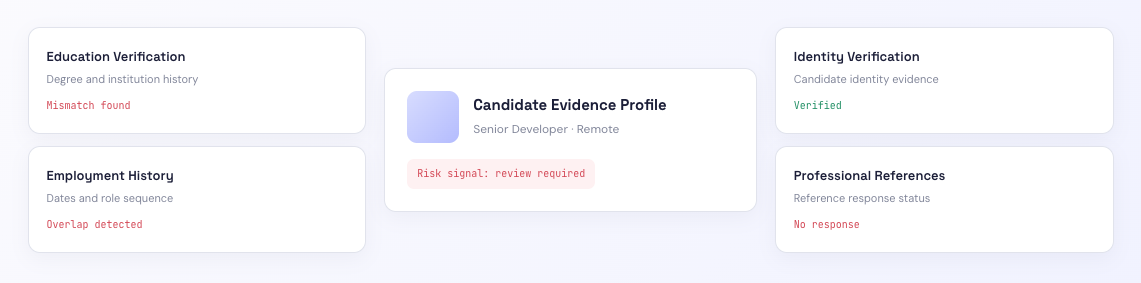
Remote hiring has widened access to talent, but it has also made candidate verification more complex. A polished resume and fluent video interview do not always prove that the person applying is the person represented by the application.
The goal should not be to treat every inconsistency as fraud. Strong review looks for patterns across identity, employment, education, references, portfolios and interview evidence, then determines whether those signals justify deeper verification.
1. Why fake candidates are a growing remote hiring risk
Fully remote recruiting can move from sourcing to onboarding without an in-person meeting. Interviews happen by video, assessments are completed online, documents are uploaded digitally and equipment may be delivered directly to a candidate.
That creates more points where one person can present another person’s information, where a proxy can complete an assessment, or where employment and identity evidence can be altered before a hiring decision is made.
The most useful fraud signal is rarely one strange detail. It is the pattern created when several pieces of candidate evidence do not agree.
2. Common types of fake candidates
Candidate misrepresentation can range from resume exaggeration to full identity substitution. These situations should not all be treated the same way.
Resume Misrepresentation
Employment dates, seniority, responsibilities or outcomes are altered or overstated.
Proxy Interviews
Another person completes part or all of an interview or technical assessment.
Borrowed Identity
An applicant uses another person’s identity or professional history.
Synthetic Profiles
Real and fabricated evidence is combined into one apparently credible candidate profile.
3. Warning signs to watch for
Signals become more useful when they are compared across sources. Recruiters should focus on contradictions that can be explained and verified rather than using superficial characteristics as shortcuts.
4. How AI-powered verification helps
Candidate review becomes more consistent when evidence is organised into comparable signals instead of being checked manually in isolation. AI can help surface contradictions, missing support and areas requiring human follow-up.
Turn candidate evidence into decision-ready Insights
Structure candidate evidence, surface inconsistencies and support more confident hiring decisions.
Explore Candidate Risk Assessment5. Keep candidate verification fair and defensible
Verification should be consistent across candidates and focused on evidence relevant to the hiring decision. A contradiction should lead to a question or additional check, not an automatic conclusion.
| Signal | What it may indicate | Next step |
|---|---|---|
| Date inconsistency | Formatting error, overlapping role or unsupported history | Ask for clarification |
| Reference mismatch | Outdated contact details or unsupported employment claim | Verify through another source |
| Portfolio inconsistency | Team contribution or unclear authorship | Use live work discussion |
| Identity conflict | Incorrect documentation or higher-risk mismatch | Escalate through approved verification process |
Strong remote hiring systems therefore combine structured evidence review with human judgement. The goal is not to eliminate candidates who look unusual. It is to make sure the hiring team can explain why a candidate was cleared, questioned or escalated.